


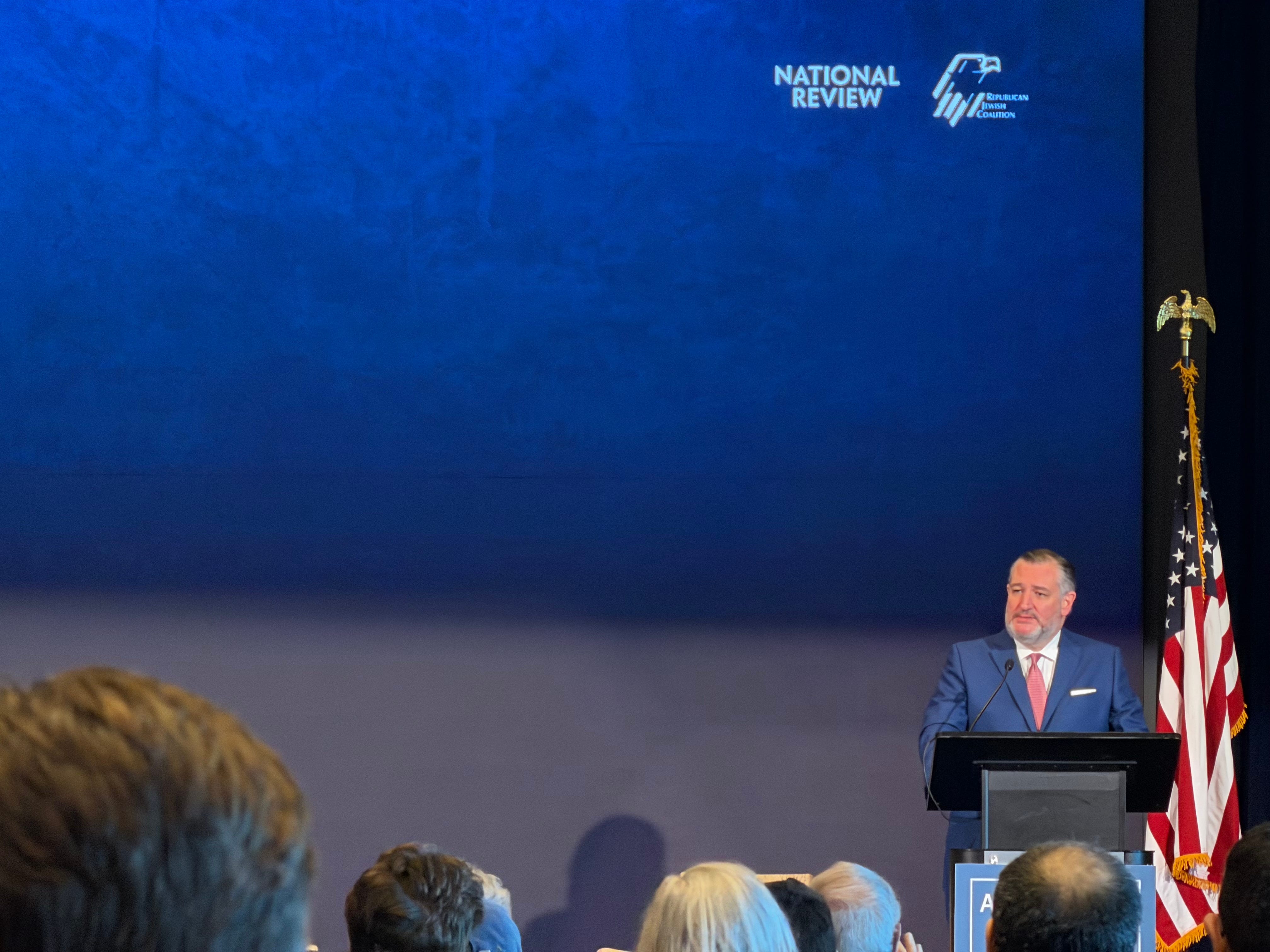
The Museum of the Bible in D.C. was tastefully arranged for war. Not the military conflict in the Middle East, but a discussion of one here at home. Three ornate chandeliers overlooked a sizable crowd for the Republican Jewish Coalition’s (RJC) symposium on antisemitism, done in partnership with National Review.
Elder donors sat in formation by the stage. I sat in the very back with the rest of the media and our staff writer, Lee Becker. Hill staffers flitted in and out as their bosses took and surrendered the stage. The energy was decent—not defeatist but not triumphant. It was a very different event than the RJC leadership conference just months prior in Vegas. It was also a very different political moment.
Junto attended to determine where institutional conservatism stood on the issue of antisemitism, mainly to see if they “knew what time it is.” These events are usually some mix of boilerplate rah-rah Israel, grrr antisemites, clap at the right moments, and go home.
And there was some of that. Chuck DeFeo, head of National Review, opened by arguing that our influencers and algorithms concentrate antisemitism. Sen. Jim Banks gave the customary condemnation: antisemitism has no place in America, no place in our politics, and no place on the right, and got the obligatory applause for it. Fine.
Something had shifted, though, since the last time an event like this took place.
An Asymmetric War
The first thing apparent when watching politicians try to address the antisemitism-on-the-right problem is that this is an asymmetric conflict, and the institutional side has not yet realized it is the one at a disadvantage.
The pro-Israel institutional right has all the conventional firepower in the world: think tanks, legacy media, donor money, floor speeches, and, indeed, symposiums at the Museum of the Bible. This is very similar to the American military advantage we possess in our war against Iran. The other side, anti-Israel influencers and their audiences—who must be discussed as a bloc even though anti-Israel and antisemitic are not the same thing—has none of that. What they do have is asymmetry itself. They are fighting on platforms that the institutional right barely understands for an audience it has already lost.
The characteristics that make someone an effective senator or institutional media figure are the same that make someone invisible on the platforms where antisemitism and anti-Israel sentiment spreads. Politicians and institutional media are trying to do battle with influencers but the mediums, audiences, and incentive structures are different. As we have seen, you can have all the influence in Washington and still lose if the battlefield is podcasts, group chats, and TikTok.
Sen. Tom Cotton was the embodiment of this dynamic. He gave the strongest speech of the opening session, condemning “influencers on the erstwhile ‘right’” and drawing his line in the sand: “I do not agree that I share a political movement or party with anyone who traffics in antisemitism… shares Liz Warren's economic policies, or Rashida Tlaib's foreign policy." He employed the now common technique of elevating the argument beyond antisemitism alone and chaining it to a general policy temperament. Anyone on "that side" is, by definition, not on the right at all. It is no accident that Cotton went the most viral of any speaker not named Ted Cruz at the symposium. The pro-Israel crowd loved it while the anti-Israel crowd hated it, as designed. The people who most need to hear it—admittedly, probably a small number—will never encounter it, because they don't watch C-SPAN clips of think tank conferences.
This is a fundamental problem, and several speakers showed signs of understanding it.
What Changed
The first panel raised an important idea. Tal Fortgang, speaking with Philip Klein, Rabbi Meir Soloveichik, and Matthew Continetti, made what I think is a genuinely significant rhetorical move: Rather than the standard invocation of "Judeo-Christian values," he argued that Jews should actively help bring Christianity back as the central pillar of the public square. That Jews should "actually provide something in their partnership with Christians by joining up to help defend Christian ideals as stridently as they have Jewish ones."
This goes beyond the familiar Judeo-Christian co-optation you usually hear from these voices.
A Jewish intellectual, at an institutional Jewish conservative conference, explicitly argues to embrace America as a Christian nation and argues that Jews should invest in that project. Your priors determine whether you find that encouraging or alarming, but it is an interesting rhetorical move in the current political climate.
This panel continued to make the case for Israel and against Iran in the same breath as the case against antisemitism, which is common, though decoupling antisemitism from other issues would be more compelling. But, on the next panel, David Azerrad said something I have believed for some time but have rarely heard acknowledged in these rooms.
David argued that in an age of populism and nationalism, if the soil is becoming America First, some of the rhetoric of Israeli defense is becoming off putting. This may not be a novel concept in the abstract, but it was totally absent at the RJC conference mere months ago. Hearing it from a panelist at a symposium on antisemitism is genuine progress. The pro-Israel right is beginning to grapple with the fact that its messaging was built for a movement that no longer exists.
Ted Cruz and the Diagnosis
Then, Sen. Ted Cruz took the stage and became the main event.
Cruz did something none of the previous speakers had done in earnest: he disagreed with the premise that “we are winning.” While others condemned the rise of antisemitism, even slipping into self-congratulation about the mainstream resistance to antisemitism citing poll data and other figments, Cruz pointed out the obvious: the people in that room were already persuaded and the people who aren’t were nowhere near it. He said: “The fact that the people in this room are persuaded doesn't mean that the interns at Heritage, at CPI, in Congress, or on the college campuses are persuaded." If anything, I believe he was underplaying the situation.
He called Tucker Carlson “the single most dangerous demagogue in this country” to sustained applause. He also noted that “virtually all of my colleagues on the Republican side have agreed with me about Tucker, but they're all afraid to say his name," and argued that antisemitism is a gateway to anti-capitalism and anti-Americanism, a "green-red alliance" of Marxists and jihadists united by a common enemy.
Cruz was substantive and direct and also unavoidably himself. One of the most caricatured figures in Republican politics serving as the most prominent advocate for the anti-antisemitism campaign. This is the asymmetric war at its essence: the institutional conservative’s chosen fighter is a man whom the enemy has already decided to laugh at.
He acknowledged this directly, quipping about edited photos of himself in an Israel-flag bikini. But it’s a self-defeating dynamic. At a fundamental level, among those who need to be persuaded, Tucker Carlson is cool and compelling. Ted Cruz comes across as the professor whose class no one wants to take.
If you believe that this is a war of words that can be won, the right would need compelling voices that don’t register as scolds and can discuss things in a rhetoric young people won’t find offputting. Ted Cruz is not that voice, and his willingness to be The Guy may paradoxically make it harder for those better suited to emerge, or at least degrade the credibility of the rest of the movement.
He also made what I think is a continued core mistake of the entire discourse: tying antisemitism to an expanding constellation of adjacent issues. Iranian foreign policy, Qatari university funding, foreign media strategy and influence operations. All relevant individually, but together and as a part of this conversation dilute the central point for anyone who isn’t already a believer.
Half the room got up and left after Cruz spoke, including reporters from several major outlets. A theory, not my own, is that the antisemitism debate is a proxy for the broader conflict over what the conservative movement will become—who defines it, who is excised, and why. The attendees who remained wanted to talk about Israel and Tucker Carlson, but the ones who left already captured the real story, which is the fracture itself.
What This Means
The good news for anti-antisemites and their allies: in the span of a few months, the institutional right went from the usual talking points to acknowledging that its messaging has failed, its coalition assumptions are outdated, and that the threat from within may be winning. That is genuine progress, and I think the RJC ran a valuable event in the face of structural weaknesses.
The discouraging element is that the diagnosis has outpaced the capacity for treatment. The people who understand the problem are either structurally incapable of reaching the right audiences, ideologically blocked from making good concessions, or easily caricatured as ineffective messengers. The symposium’s most important insight, that the captains have picked their teams and you will not convince many defectors, hung over the room.
The institutions built to fight antisemitism were designed for a movement that took its cues from National Review and the Republican Jewish Coalition. That movement is gone or quickly disappearing, and in its place is one that takes its cues from group chats and algorithms. In these conditions, the institutional right keeps bringing battleships to a drone war. The opposition knows it will get pummeled in the think tank white papers, institutional media, and on the Senate floor, and they don’t care.
Until the institutional right builds something that responds to the movement where it actually lives and breathes, events like this will remain rooms full of people who already agree, refining their arguments for an audience that is not listening.
“Your priors determine whether you find that encouraging or alarming,”
What if my priors are DGAF and to the extent I can find a quantum of fucks to rent out on time share my quanta is Sick of Hearing about it 🤮?
Israel has enormous advantages in all respects for a little known but vital example AI data centers and NVIDIA et al are vitally invested in Israel. We can go on&on.
Israel has one enemy worthy of mention and it’s Foggy Bottom et al.
🏴☠️
Israel’s greatest weakness in America is her overexposure and her worst enemy is her own ostentatious attention whore “allies”, her second worst enemy her American donors of all sorts and spectrum.
Let MBS and UAE lobby for 🇮🇱 we see they’re more effective.
Certainly quieter.
From Benevolence as I tire of DC betraying all Foreign and Domestic;
If ye would survive get off the screen.
Get off the screens.
Only Indian telemarketers and spammers are more ubiquitous and maddening but at least few Americans know who Modi is… all know who Bibi is … get off the screen. A valid complaint against antisemitism is Jews get blamed for everything, this would have less purchase if they weren’t ubiquitously ostentatious and popping up everywhere. Sometimes massive reinforcement doesn’t work. So STFU, from benevolence.
The sacrifice of professional political people’s income stream to the greater good of the cause an excellent character test; Get off the screen even IF that means loss of income.
Find another Trick to Turn, my fellow Americans.
Let the Gulf Arabs handle pro Israeli lobbying, that’s one of the many gifts of the Abraham accords.
Let 8200 🤓 alumni lobby in private Zyn filled rooms, let NVIDIA et al lobby, let Kushner lobby and let the Americans not hear of any foreign countries especially the MidEast.
They’re better at it as we see. Let victory close the account. Then STFU so 🇮🇱 can be safer.
Here ends quantum of GAFs. Think it over.
Get off the screens.