


The question of the moment is “why now?” Why did the Trump administration launch a comprehensive military campaign against Iran, at this moment, with all the risk and cost that it entails?
The answer is North Korea.
When you allow a hostile state to build a credible military deterrent it becomes permanent and untouchable. A problem that can never be solved, only managed, at enormous cost, forever. Every president for decades has known that the cost of “solving” the North Korea problem is a price far too high to pay—the regime cannot be dislodged without civilizational catastrophe.
Iran has been building towards the same deterrent. The Trump administration understood that the window to prevent a second North Korea was closing, and closing quickly. Every failed intervention moved Iran closer to the point of no return. The pressure to act now was strategic because the lesson of North Korea is that once the door locks, it is locked forever.
The Conventional Shield
North Korea’s conventional deterrent is built on blunt geography and positioning. The demilitarized zone and much of the terrain north leading to Pyongyang is liberally ornamented with pillboxes, bunkers, and reinforcing obstacles.
Nearby, in the mountains, thousands of hardened artillery sites (HARTs) are hewn into the rock, aimed squarely at Seoul and its population of ten million people. They are fixed, often on tracks, optimized to roll out, pre-aimed, and fire from just behind the terrain before returning to cover. Even with extensive counter-fire artillery, any military action against North Korea means accepting that Seoul takes catastrophic damage in the opening salvos.
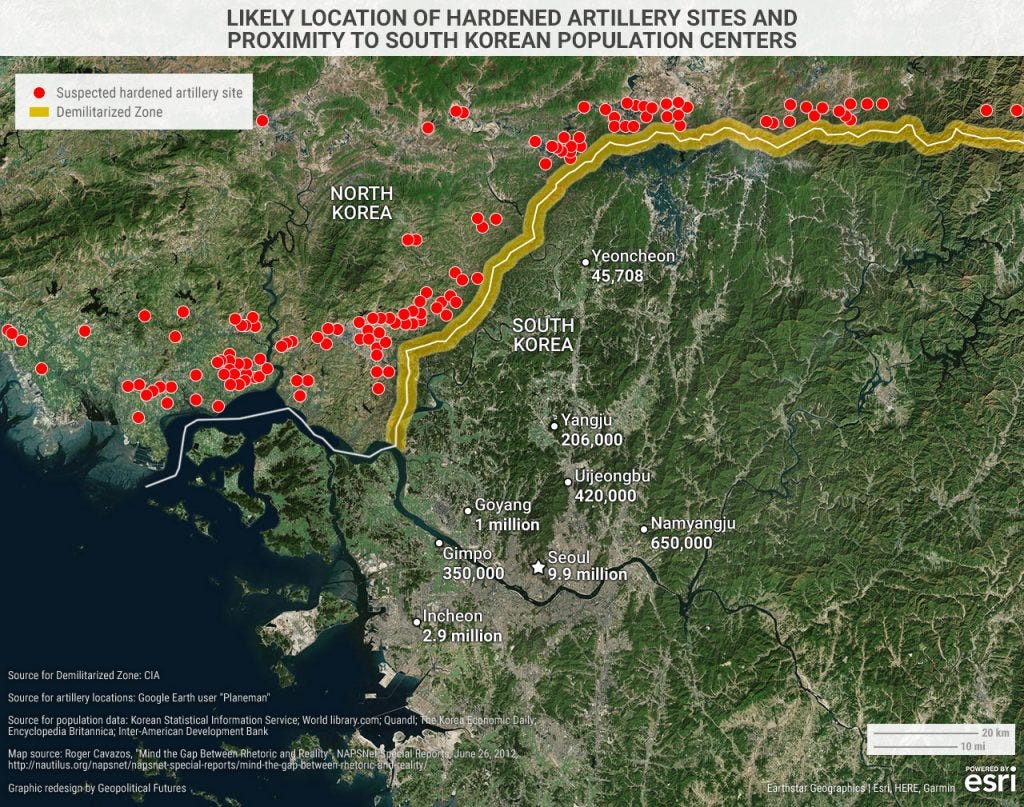
This is the foundational defense that has made North Korea untouchable for decades. Certain destruction of a major city, combined with the prohibitive cost of digging the North Koreans out from their own terrain—the very mountains militarized against potential invaders.
Iran’s version of this is its ballistic missile program, ironically built with direct assistance from North Korea. The Shahab series of medium-range ballistic missiles (MRBMs) are descendants of North Korean NoDong missiles, transferred in the 1990s. Iran has since developed indigenous systems with increasing range, accuracy, and numbers.
In recent days the Trump administration has revealed that Iran began to heavily expand their missile stockpile and production capacity.
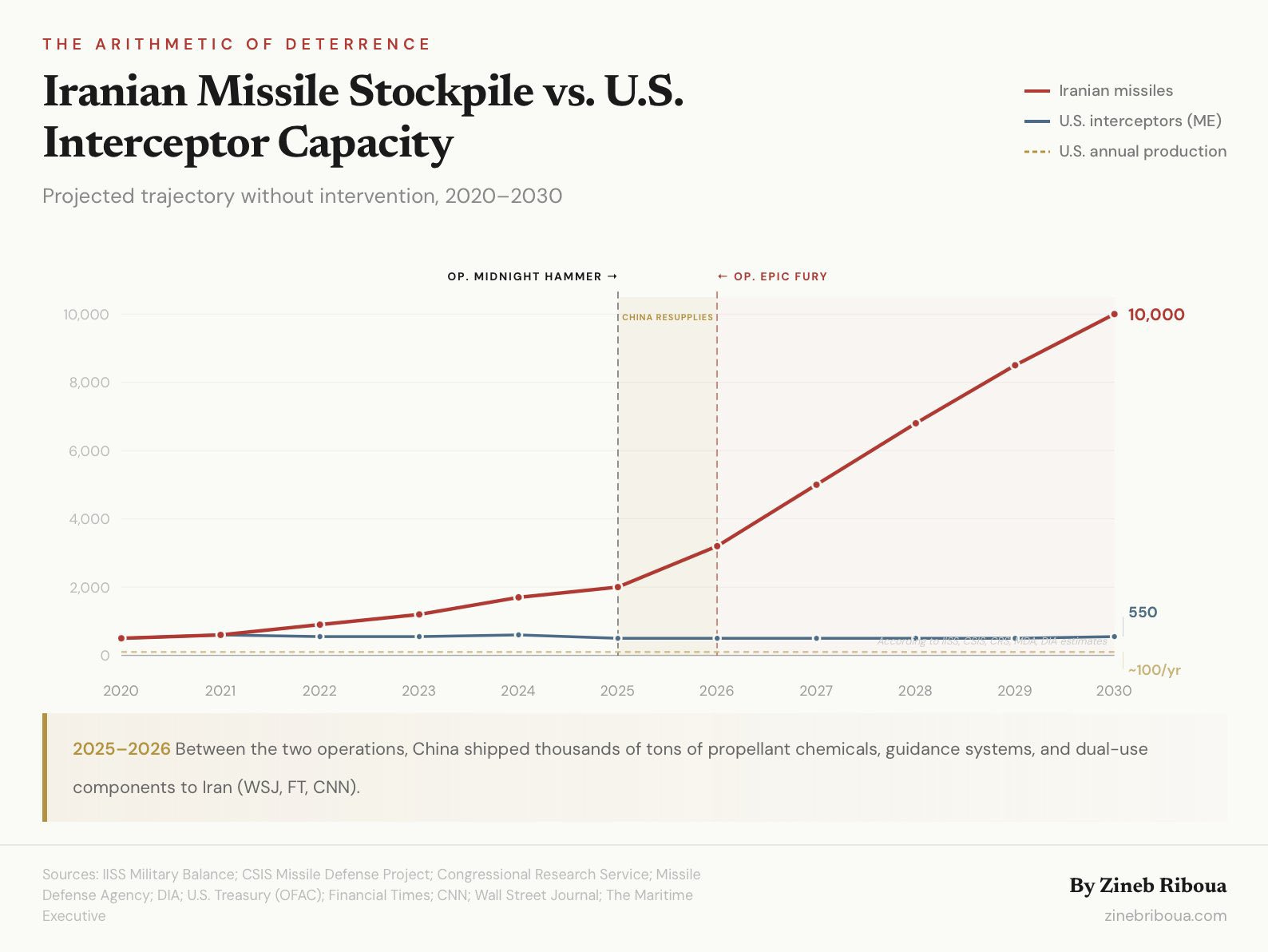
Iran was pursuing an overwhelming conventional ballistic missile deterrent to make the cost of military action so high that we could not threaten them. Meanwhile, they continued working towards the thing that makes you permanently untouchable.
The Nuclear Umbrella
The artillery aimed at Seoul kept the United States and South Korea from acting while Pyongyang developed and miniaturized nuclear technology. By the time the world recognized the full scope of the program, the window for intervention had passed. A nuclear-armed North Korea could not be regime-changed or coerced.
Iran has been running—increasingly, sprinting—towards the same goal. Its nuclear program has been the subject of diplomatic theater for two decades. The JCPOA, the IAEA inspections, the enrichment caps that were agreed to and then exceeded. Iran has moved closer to weapons-grade enrichment and weaponization with each passing year. The conventional missile arsenal would exist to buy time for this program, exactly as North Korea’s artillery bought time for theirs.
The Asymmetric Networks
North Korea is fully committed to an asymmetric threat. Hundreds of thousands of Special Operations Forces (SOF) trained for unconventional warfare to sow chaos behind enemy lines. Military speedboats tasked to infiltrate the eastern and western coasts. Thousands of airborne troops to paradrop into South Korea in the event of a conflict. Ballistic missile submarines. Chemical weapons. In sum, much of their military is designed with the sole purpose of making a conflict too costly for their adversary.
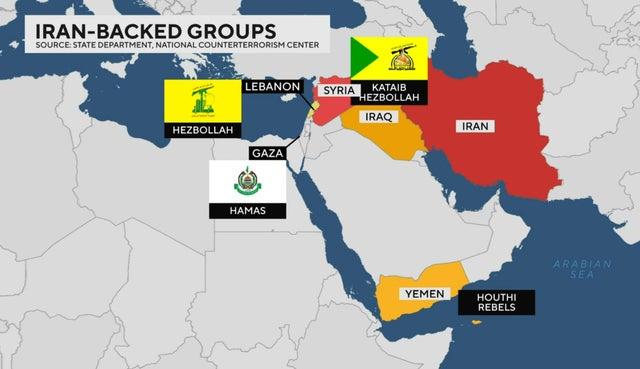
The Iranian equivalent is its militia network. Hezbollah, the Houthis, Iraqi Shia militias, and various Palestinian groups represent a distributed asymmetric coalition operating throughout the region. Where North Korea’s SOF would deploy locally, Iran’s proxies can strike across an entire region. They serve the same purpose: raise the cost of conflict beyond what any adversary is willing to pay, and do it through means that are difficult to deter or destroy.
Both countries understood that a conventional military alone isn’t enough to prevent regime-change from a militarily superior power. You need forces that are capable of imposing costs far out of proportion to their size.
The Economic Lifeline
North Korea persists through a creative juggling act of illicit activity. It sells military training to African police and military units, runs cyber operations that steal billions in cryptocurrency, and exports laborers to Russia, China, and the Middle East to generate foreign currency for the regime. Its economy is admittedly tiny, but the regime’s survival budget is funded by activities that exist entirely outside the legitimate global economic system. This is why it has been so difficult to control them through sanctions and economic pressure.
Iran’s version is simpler and much more useful. Oil. Despite decades of sanctions, Iran has continued to export crude to countries like China, generating the revenue that funds its military, its nuclear program, and its proxy network. Where North Korea built its deterrent on a relative shoestring budget, Iran is building the same ecosystem using materially greater resources.
A nuclear North Korea with oil revenue is harder to outlast and harder to contain. It is impossible to wait for the regime to collapse under economic pressure (which has failed for seventy years with North Korea) when they have some of the largest oil reserves in the world.
The Window
Every facet of Iran’s strategic deterrent mirrors North Korea’s. They were pursuing an expanded conventional deterrent, a nuclear program, asymmetric forces, and a sanctions-resistant economy.
The only difference is that Iran had not finished yet.
North Korea finished its conventional and nuclear deterrents and became permanent. No amount of economic or diplomatic pressure has managed to change the status quo on the Korean Peninsula. The Kim regime will likely persist indefinitely because the cost of removing it is higher than any country is willing to pay.
Iran was on the same trajectory. Every month that passed without decisive action moved it closer to the point where the same logic applies. Once Iran crosses the nuclear threshold with a nuclear-capable ballistic missile, the calculus changes permanently.
The administration had watched this trajectory for months. When the latest round of negotiations began to collapse, the questions became unavoidable. Allow Iran to continue running the clock on its missile stockpile and enrichment program, or accept that the window was closing in real time. Operation Epic Fury was their answer.
The strikes currently underway are not about punishing Iran for past behavior, though that behavior certainly meets the threshold for a Just War. Trump and the administration are trying to close the door on Iran before it could finish its deterrent. Whether the war succeeds in closing that window permanently remains uncertain, but the cost of waiting was increasingly clear.
Why Iran Is Worse
North Korea, for all its bluster, is largely a defensive problem. Just about every institution and strategic move made by the regime is in the sole pursuit of self-preservation. It is a hermit kingdom with a nuclear weapon, dangerous but contained to its own devices.
Iran, on the other hand, is not contained. Iran is the most persistent adversary the United States has faced since the Soviet Union.
Where North Korea is a problem we failed to prevent, Iran is a long-standing enemy we have failed to confront. The Marine barracks in Beirut. The IEDs that killed hundreds of American soldiers in Iraq. The proxy network that has bled American allies for four decades. The order to assassinate President Trump. No other adversary since the Soviet Union has inflicted such sustained, direct costs on American lives and interests like Iran has.
We already have one permanent, nuclear-armed rogue state that no president can touch. The administration bet that a risky intervention now was preferable to continuing a problem that compounds forever. History will judge whether they were right, but the logic behind that decision is not difficult to understand.