


Three members of the San Antonio city council are socialists.
Not San Francisco. San Antonio, a military town in a red state that hasn’t elected a Dem to statewide office in decades.
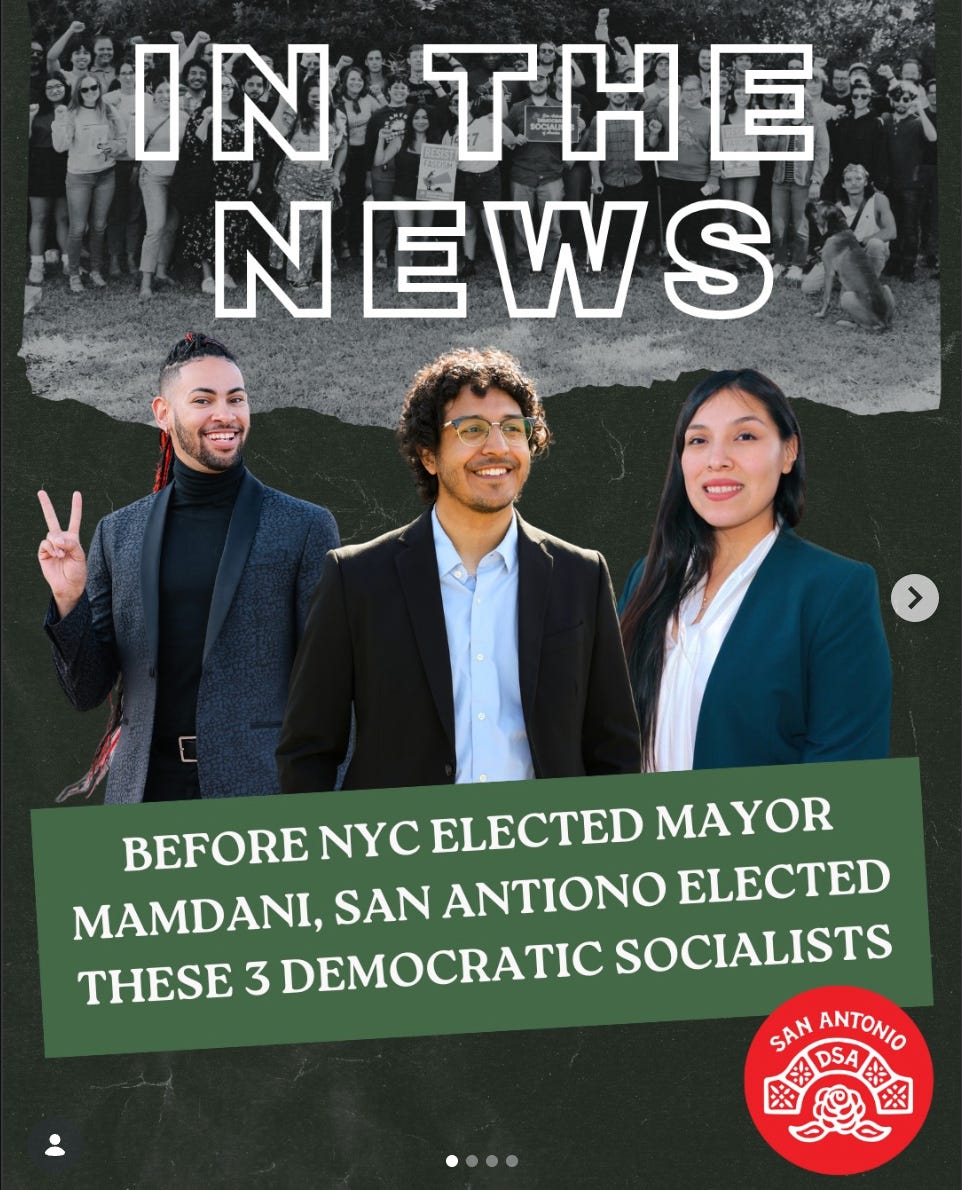
There has been minor hand wringing, but within the national conservative hivemind, not much noise about it.
Instead, Republicans are in a triumphalist moment. Trump 2.0 has delivered on foreign policy, immigration, and institutional reform at a pace that would have been unimaginable four years ago. The GOP holds the White House, has remade the judiciary, and forcefully driven the Democratic Party into the sea of identity crisis. The left appears broken, leaderless, and reduced to performative outcry.
However…
Over the last two decades, America has moved further left than most Americans in 2004 could have ever imagined. Culturally, institutionally, legally, the transformation has been enormous and largely irreversible. Same sex marriage, DEI policy, the Overton window, even our perception of the role of government has shifted so far that Bill Clinton in the 90s would be well to the right of current Democrats.
This is no accident. Behold the progressive project, and it worked. Over two decades, the only meaningful speedbump has been President Trump.
National transformation, however compelling, isn’t the whole story. Underneath the federal back-and-forth, there is a local project expanding that almost no one is talking about.
The socialists understood something that the rest of the left is still learning and that the right rarely considers at all. The federal government changes hands, but city councils are mostly ignored. Housing policy is local. Zoning is local. Policing, transit, schools, public budgets—all local. Decisions are being made in rooms that most voters never enter and most conservatives have abandoned entirely.
DSA strategy isn’t new, but the results are accelerating. In 2017, thirty-five DSA members held elected office in the United States. Today that number exceeds 250, a sevenfold increase in eight years, with nine out of every ten elected after 2019. San Antonio is part of this national pattern. So are the seven DSA aldermen in Chicago, the four in Portland. Small wins individually. Collectively, a growing footprint in precisely the places the right has retreated from.
Then there’s New York.
Mamdani’s election was the Big Thing. Within weeks of taking office he canceled a planned expansion of 5,000 NYPD officers, let some dozen homeless die in a cold snap, and began restructuring city agencies around an affordability agenda drawn straight from DSA priorities.
The right treated this as an alarming curiosity, a blue-city novelty and the predictable result of Curtis Sliwa splitting the vote. Now he’s the cable news boogeyman for an abandoned metro we have no intention of fighting for. But he’s part of the pattern.
The DSA is not running a national campaign. It is building municipal infrastructure, city by city. It is doing precisely what the right has failed to do for a hot minute.
As a movement, the left has not aged out of the end of history. The mainstream Dems still believe in demographic inevitability, national elections, and a focus on federal power. But that faction is increasingly exhausted. They lost to Trump twice in the popular imagination even when they won the electoral college once. Their national bench is thin and they can’t decide on whether they’re the party of the working class or the party of institutional progressivism.
But the DSA wing has moved beyond all of this. Not all of them yet, but the ones who are building in San Antonio and are running New York City have figured out something that the DNC has not. Durable power can be built from the bottom, where it’s cheaper and where the right pays far less attention (and where the DNC is probably less territorial.)
The conservative response to this has basically been nonexistent, because the conservative media ecosystem rarely gives a shit about local political infrastructure beyond scary stories for our Beltway magazines. We fight over congressional seats, build think tanks in D.C. to write white papers read only by ourselves, and argue about whether Tucker Carlson and Candace Owens are warriors for truth or crazy and compromised. Meanwhile, we leave city councils, school boards, and municipal elections to whoever shows up.
I wrote last year about the broken windows of American government. The thousands of small civic failures and local institutional collapse. The argument was that American national decline is rooted in the cumulative neglect of local governance.
What San Antonio and New York and Chicago and countless other places have made clear is that those broken windows don’t stay empty. Someone is filling them, and the people filling them are increasingly DSA members who understand that a city council seat in red Texas is worth more than 100 op-eds about “The future of the left.”
The right needs to seriously reckon with whether it wants to actually contest the ground where Americans live or whether it's content to win the presidency every eight years and wonder why the country keeps moving left even when Republicans are in power.
The DSA has made its decision.